Saved, Screened, Sorted: How to Build a Hair Mood Board Your Stylist Can Actually Use
It usually starts with a screenshot. Maybe it is a model on Instagram with a soft, face-framing bob. Maybe it is a celebrity with a curtain fringe that falls exactly right. Maybe it is a Pinterest image from three years ago that you have saved so many times it now feels like a personal goal. You bring it to the salon, hold up your phone, and say: ‘This one.’ And then comes the gentle pause.
That pause is not a stylist being difficult. It is a professional translating. Because a phone photo can tell us a mood, a colour, a silhouette, a feeling — but it rarely tells us the whole story of how that hair behaves in real life. The camera roll cut is one of the most common consultation mismatches in the chair, and it is worth fixing before your next appointment.
The photo is not a blueprint
A photograph is a flattened moment. It has been lit, posed, styled, filtered and often photographed from the most flattering angle. The hair may have been tonged into place ten minutes earlier, or it may be a wig, or it may belong to someone with three times your density and a completely different growth pattern. None of that is a problem in itself. The problem is when we treat the image as a technical instruction rather than a visual reference.
Ring lights are especially sneaky. They lift shine, smooth texture and make ends look cleaner than they do in a bathroom mirror. Filters can blur frizz, soften cowlicks and make a fringe look like it falls effortlessly when, in reality, it has been trained with a round brush and a lot of patience. In the salon, under natural light and with your own hair in its usual state, the same cut can look quite different. That does not mean it is a bad cut. It means it was never a copy-and-paste job.
What your stylist is actually reading
When a good stylist looks at your inspiration photo, they are not just looking at the shape. They are looking at density — how much hair there is to work with. They are reading texture — whether it is fine, medium or coarse, straight, wavy or curly. They are noticing the growth pattern at the crown, the way the fringe falls from the hairline, and whether the model has a heavy front section or a lighter one. They are also looking at the styling. Is that a wash-and-go? A blow-dry? A tonged wave? Would it survive a Manchester drizzle or a windy walk to the bus stop?
This is why the same photo can lead to two completely different cuts on two different people — and both can be right. The image is a starting point, not a contract. Your stylist’s job is to adapt the idea to your hair, your face shape, your routine and your willingness to style it on a dark November morning.
The wet Tuesday test
Before you commit to a screenshot, run it through the wet Tuesday test. Imagine the hair after a commute in British weather. Imagine it after a night’s sleep. Imagine it with five minutes of styling, not fifty. Does the shape still make sense? Does the fringe still fall somewhere near your eyes? Does the back still look intentional when it has not been tonged into perfect bends?
If the answer is no, the photo may still be useful — but as a detail rather than a full cut. You might like the softness at the ends, the way the layers move, or the length of the fringe. Those are the bits to point out. That is much more helpful than asking for the entire image to be recreated exactly.
How to build a screenshot folder that works
A useful mood board is small, specific and honest. Aim for three to five images, not thirty. Include a mix: one front-on shot, one side profile, one back view if you can find it. Look for images taken in natural light, without heavy filters. If you can find a video of the hair moving, even better — movement tells a stylist more than a perfectly still pose.
Then add your own hair. Take a photo of your current cut in daylight, unstyled or minimally styled. Take one of your hair after washing and air-drying. Take one of the back. This gives your stylist a real baseline. It also stops the conversation from becoming a comparison between your everyday hair and someone else’s professional styling.
Annotate your screenshots. A simple note like ‘love the fringe, not the colour’ or ‘this softness at the ends, but keep my length’ saves a lot of guesswork. Include one ‘no’ image too — a cut or fringe you definitely do not want. Sometimes knowing what to avoid is just as useful as knowing what to aim for.
Be honest about your routine. If you never blow-dry, say so. If you own a tong but only use it for weddings, say that too. If you have fine hair that goes flat by lunchtime, your stylist needs to know. The best cut is not the one that looks most impressive on a screen. It is the one that fits your actual life.
The consultation script
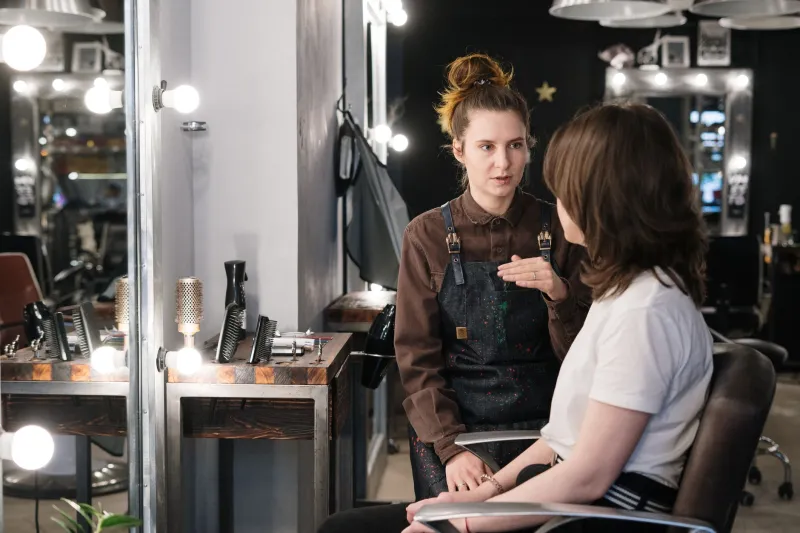
You do not need to become a hair expert to have a good consultation. You just need to be clear. Try: ‘I like the shape here, especially the way the layers sit around the cheekbone, but I do not want to style it every day.’ Or: ‘I love this fringe, but my hair is finer than hers — can we adapt it so it does not sit flat?’ Or: ‘I am not asking for this exact colour; I just like the warmth.’
If your stylist suggests a tweak, listen. They are not dismissing your inspiration. They are protecting you from a cut that looks great in a photo and awkward in the mirror. The best appointments are a conversation, not a download.
The cut you can actually wear
A mood board should open up the conversation, not close it down. The goal is not to arrive with the perfect screenshot and leave with an exact replica. The goal is to leave with a cut that suits your hair, your routine and the weather outside the salon door. If it works under a ring light, great. If it also works on a wet Tuesday, even better.