Blades, Not Pictures: How the Shears Behind the Chair Shape Your Cut
You've done the research. There are eleven screenshots on your phone, three of them the same bob from different angles, and a note in your head that says this time, properly. Then you sit down, the gown goes on, and the person behind the chair reaches for a pair of scissors that has absolutely nothing to do with your saved folder.
That's not a red flag. That's the craft.
At Scissors Hair Salon we talk about this a lot, because the single biggest gap between the photo in your hand and the hair on your head usually isn't the trend — it's the blade, the angle it's held at, and the technique it's used for. Two stylists can give you the same brief and produce two completely different bobs. Here's what's actually happening on the trolley.
Two pairs of shears, two very different bobs
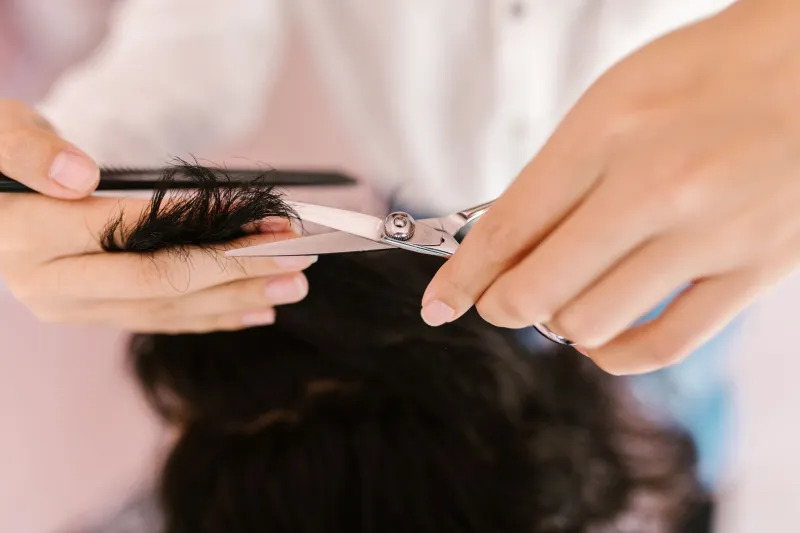
Start with the plain, straight cutting shear — the one that looks reassuringly ordinary. Its job is a clean line. It sets the perimeter of a cut, decides how heavy or light the ends feel, and is the reason a blunt bob reads as sharp rather than soft.
Use it on fine British hair and it preserves density, because nothing has been taken out. Use it on thick, heavy hair with no follow-up work and you'll get a solid block of weight sitting on the shoulders. Same blade, two outcomes — which is why a stylist who only ever reaches for one pair is probably not going to nail both.
The thinning shear, and the number that matters
Here's the one that causes the most confusion. Texturising shears come with a tooth count, and that count is the whole story. A 46-tooth shear removes a whisper of weight per snip. A 30-tooth — or anything lower — takes out considerably more. Neither is better. They're just different tools with very different consequences.
Ask any stylist who has inherited a rescue job: fine hair that has been generously thinned with a low-tooth blade will look full in the chair and stringy by week four. Thick hair that has never been texturised will sit flat and heavy no matter how many layers you ask for. If you hear a lot of dry, crunchy snipping through your mid-lengths and you have fine hair, it is completely reasonable to ask what's being used back there.
Point cutting, sliding and razoring: movement, three ways
If you want softness rather than a hard line, the blade goes in at an angle.
Point cutting takes the very tips off on a diagonal, which is why it's the go-to for fringes, grown-out layers and anything that needs to blur rather than blunt. It's discreet, forgiving, and almost invisible on day one — you notice it in how the ends fall, not in how they were cut.
Slide cutting runs the blade gently down the hair shaft, taking a sliver as it goes. The result is a lived-in, slightly undone surface with real movement. It's beautiful on medium to thick hair and needs a genuinely sharp shear and a confident hand; used carelessly on fragile hair, it can leave things looking wispy.
Razor work is the boldest of the three. It creates that feathery, shag-adjacent softness that photographs so well, and it is merciless on over-processed or very fine hair. Not a villain — just a tool that requires an honest conversation about your history with bleach.
Curved blades and the fringe question
Less talked about, endlessly useful: curved shears. A slight curve lets a stylist follow the line of the brow or the shape of the face instead of cutting a flat horizontal across your forehead. That's the difference between a fringe that looks intentional and a fringe that looks like it was decided in a hurry. If you've ever had a fringe cut straight across and wondered why it felt blunt in every sense, this is usually the answer.
Wet or dry is part of the picture too
Blade choice rarely travels alone. Dry cutting lets a stylist see how the hair actually falls when there's no water weighing it down — invaluable for curls, waves and anyone whose hair shrinks up the moment it dries. Wet cutting gives precision and a cleaner line. Many cuts use both, in sequence, with different shears for each stage.
So when your stylist says the detail work will happen dry, that isn't a shortcut. It's a decision about what they need to see.
The real test is the sixth week
A cut isn't finished when you leave the chair — it's finished when it's grown out. This is where blade choice quietly shows itself. A blunt perimeter grows out as a visible line. A point-cut layer softens as it drops. A heavily thinned section can start to separate and straggle.
Which is why the most useful question in the whole appointment isn't can you make it look like this photo. It's what will this look like in six weeks, with the heating on and no time to style it properly? That one question tells you whether the plan is built for your actual life or just for the mirror shot.
Questions worth taking to the chair
- Which shears are you using for the perimeter, and why those?
- Are you texturising, and with what tooth count?
- Will the detail be cut wet or dry?
- If I want to keep my length, which blade gives me movement without losing weight?
- How will this grow out by week six?
And bring the photos, obviously — but bring the words as well. I like the shape, not the length is worth more than any screenshot, because it tells your stylist which blade to pick up before they've even started.
One last thing
There's no such thing as a universally good pair of scissors, only the right pair for the head in the chair. That's the whole reason a proper consultation exists — and why, at Scissors Hair Salon, the trolley is chosen per person rather than per trend. Book a consultation, bring your folder, and ask what's being used. You'll get a better cut for it, and you'll understand exactly why it works.