Blended, Not Blocked: The 2026 Case for a Shadow Root Over a Standard Top-Up
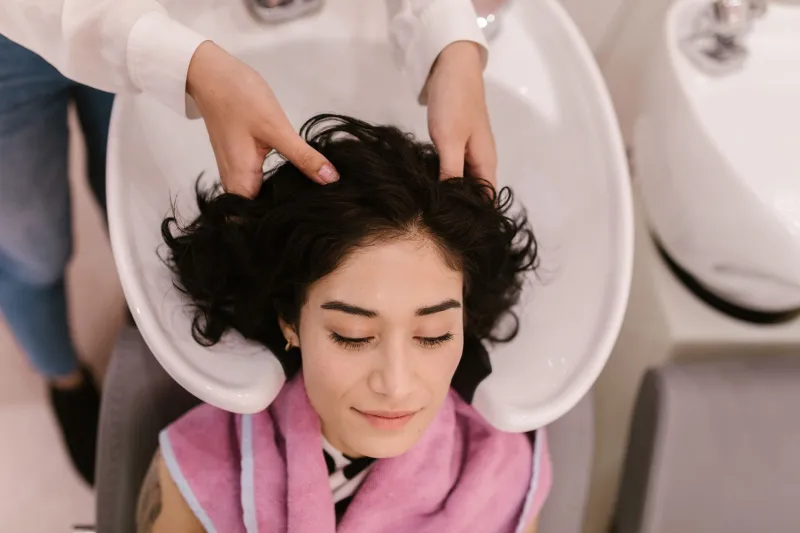
Book a root appointment and you usually get one of two things: a crisp block of colour sitting over your regrowth, or a softer wash of depth that melts down into your mid-lengths. On the phone they are both called 'doing my roots'. They are not the same appointment, and the gap between them is roughly six weeks of your year.
Two appointments, one name
A traditional root touch-up is a precise, targeted job: permanent colour painted only onto the regrowth, from the parting down to the line where your last colour ends. It is quick, it covers grey, and it does exactly what it says. The trade-off is a hard edge. For the first week nobody notices; by week four there is a faint ring around your parting, and by week six it is the only thing you can see in the mirror.
A shadow root — you will also hear root melt, root smudge, or 'soft root' — starts with the same regrowth but treats it differently. Instead of matching your base exactly and stopping dead, your colourist takes a shade half a tone to two tones deeper than your mid-lengths and feathers it three to five centimetres below the parting. Then the whole head usually gets glossed, which is where the shine comes from. The line does not disappear because it was never drawn in the first place.
Why it is having a moment in UK salons
Because it solves the specific problem most of us actually have. Very few clients in 2026 want a single flat colour from root to tip — the requests we hear most are for something that looks expensive in a photograph and forgiving in a bathroom mirror at 7am. A block colour demands upkeep. A shadow root asks for a bit of patience and then quietly gets on with it.
It also suits the way people are booking now: fewer, longer appointments, planned around weddings, holidays and the Christmas run rather than a rigid six-week rota.
Who it flatters, and who should pass
It is close to a no-brainer if:
- You have highlights, balayage or lived-in blonde and the regrowth is what ruins the whole thing
- You are covering grey at 50% or under and want the line softened rather than hidden
- You go six weeks between appointments because life gets in the way, not because you are precious about it
- You are growing out a fringe or a shorter cut and want the colour to look deliberate in the meantime
- You want to go a shade or two deeper without committing your whole head to it
Be honest about the exceptions. If your grey is resistant and dense, or you genuinely want one clean uniform colour from root to tip, a standard top-up still wins. And if your regrowth has already grown into a hard block, a shadow root layered on top will not fix it on its own — that is a correction, and it needs a proper conversation with your colourist first.
The time maths
Here is the bit nobody puts on the price list. A top-up runs four to six weeks before the line returns. A shadow root, done properly with a gloss, can comfortably go eight to twelve, because the regrowth is arriving into a soft gradient rather than a wall.
You will usually pay more for the appointment itself — think £15 to £30 over a standard top-up in most UK towns, more in city salons — because there is a second colour, a second mixing bowl and a gloss in there. But spread that across the extra month and the cost per week drops. Fewer trips, less overlap damage, less time in the chair. Not a bargain, exactly. Better value, definitely.
How to ask without ending up too dark
The failure mode is real, and it is almost always a communication problem rather than a colour problem. Say:
'A shadow root, please — about a shade deeper than my base, feathered down, not a solid block.' The words 'shade deeper' and 'feathered' are doing the work. 'Just a bit darker at the roots' can mean anything.
Bring two photos. One of what you want, one of what you do not. Colourists read images faster than adjectives.
Agree the depth before the bowl is mixed. Ask how far down it will go and how it will look against your mid-lengths in daylight. If you are blonde, be clear that you want a deeper blonde, not a brunette root.
Ask whether a gloss is included. A shadow root without a gloss is half a job; the gloss is what ties the old colour and the new together.
Ask about the exit plan. A good shadow root should still look intentional at week ten — ask your colourist how they would handle the next appointment so you are not quietly nudged back into a six-week cycle.
Aftercare that keeps it looking deliberate
The colour is only half of it. The rest is how you wash it.
Wait 48 to 72 hours before the first wash — the cuticle needs time to settle, and a shadow root is more exposed at the root than a solid block.
Switch to a sulphate-free shampoo and turn the temperature down. Hot water lifts the cuticle and takes tone with it, and in a hard-water area the build-up will dull a gloss faster than almost anything else you do at home.
Use a tinted or toning conditioner every third wash rather than every wash. Blondes, that means a violet or pearl formula; brunettes and reds, something matched to your depth. Over-toning is its own problem, and it is far harder to correct than fading.
Keep dry shampoo to the root of the root, not the whole head, and brush it out before bed. Layers of powder are what make stretched colour look tired rather than lived-in.
Book a gloss at the halfway mark. Twenty minutes in the chair resets the shine and lets your colourist check the grow-out while it is still manageable.
The long game
Root rehab is not really about a single appointment. It is about changing what your hair looks like on the days you are not in the salon — which is most of them. A shadow root buys you time, softens the thing you were trying to hide, and makes the whole colour read as a decision rather than an oversight. Ask for it at your next visit. Bring a photo. Mention the word 'feathered'.